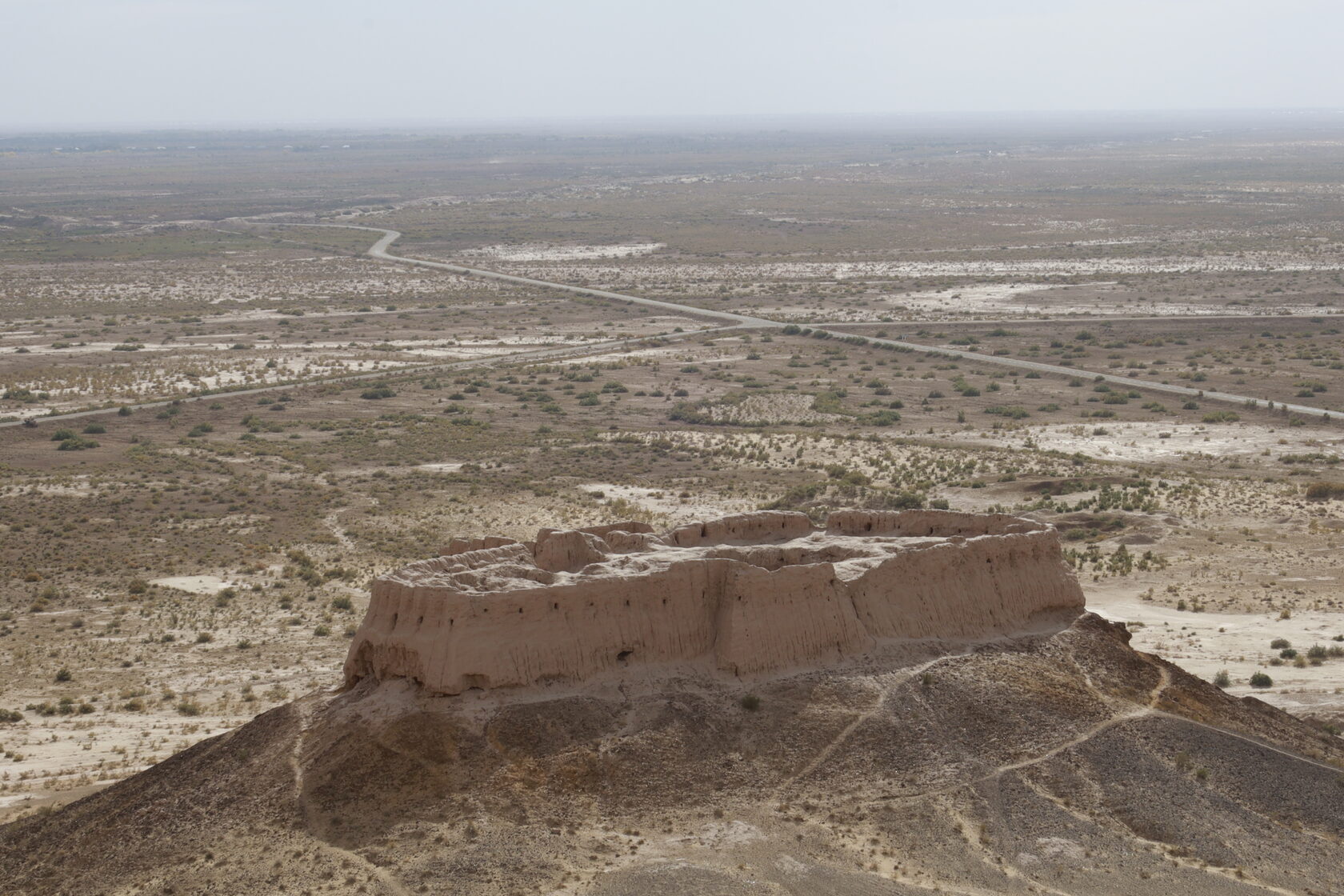
Imagine this: you stand on the crest of an ancient clay wall while the wind of the Kyzylkum Desert gently brushes your face. Below you, as far as the eye can see, stretch the ruins of fortresses that seem to have grown straight out of the sand. The sun is just rising above the horizon, painting everything in soft pink-and-gold hues. There is not a single tourist in sight. Only you, your private archaeologist-guide, and a silence that holds the voices of 2,500 years of history. This is not an ordinary excursion. This is Ellik-Kala — “Fifty Fortresses” — the very heart of ancient Khorezm, where Xanaka brings only its guests at dawn, when the world is still asleep and the past is just waking up.
Khorezm is one of the most mysterious and ancient kingdoms of Central Asia. Its history began long before the Arabs, the Mongols, or even the great Timurids appeared here. From the 6th century BC, the land along the lower reaches of the Amu Darya was an oasis of civilization: fertile fields, powerful fortresses, a unique culture, and rulers known as Khorezmshahs. Dynasties reigned here, minted their own coins, created frescoes worthy of comparison with India’s Ajanta, and kept chronicles in the Khorezmian language. Time and conquerors erased most of the traces. All that remains are ruins — and it is these ruins that Xanaka opens up for you.
From the Achaemenids to Independence: The Birth of the Khorezmian Kingdom
The history of Khorezm goes back to the 6th century BC. At that time these lands became part of the vast Achaemenid Empire of the Persian king Cyrus the Great. Khorezm turned into one of the satrapies — provinces — known as “Khvarizm.” The Persians valued it for its fertility and its strategic position on the Silk Road: caravans from China, India, and the Eurasian steppes converged here.
After the collapse of the Achaemenid Empire in the 4th century BC (following the campaigns of Alexander the Great), Khorezm gained independence. According to some sources, the Macedonian king even founded one of his cities here, although there is little concrete evidence. By the 3rd–2nd centuries BC the Khorezmians already had their own statehood: advanced irrigation-based agriculture, powerful fortifications, and their own script based on the Aramaic alphabet.
It was during this period that the first fortresses were built — the ones that would later form the Ellik-Kala complex. They protected the oasis from nomads and ensured control over the waters of the Amu Darya. Khorezm became the “Egypt of Central Asia” — a land of canals, castles, and flourishing culture. By the 1st century AD a powerful kingdom had formed here, ruled by its own dynasty, which later became known as the Afrighids.
The Afrighid Dynasty: 700 Years of Khorezmshahs
In 305 AD the Afrighid dynasty came to power — one of the longest-lived in the history of Central Asia. Its founder, Afrig (or Vazamar), took the title “Khorezmshah” — “King of Khorezm.” This dynasty ruled for nearly seven centuries — until 995 AD. The Khorezmshahs were more than mere rulers: they combined the traits of Iranian kings and steppe chieftains. On their coins they were depicted with winged-symbol crowns, bows, and emblems of power that recalled the mythical Siyavush — the legendary founder of the dynasty.
In different periods the capitals were Kyat (modern Biruni) and Toprak-Kala. It was here, in Toprak-Kala, that archaeologists discovered the residence of the Khorezmshahs. The rulers minted silver coins bearing portraits of kings and inscriptions in the Khorezmian language. These coins are one of the main sources of knowledge about the dynasty. They show the evolution of titles, alliances with neighbors (the Kushans and Sasanians), and even the influence of Zoroastrianism.
The Afrighids created a unique system of fortifications. The fortresses were built of adobe bricks — massive blocks measuring 40 × 40 × 12 cm. Each fortress was not simply a fort but a miniature city: with palaces, temples, residential quarters, and warehouses. Ellik-Kala is not fifty separate sites but an entire network of more than 300 fortifications (according to modern counts), many of which date back to the 1st–6th centuries AD. They protected the fertile delta of the Amu Darya from raids and controlled the trade routes.
Ellik-Kala: Shield and Soul of the Ancient Kingdom
Ellik-Kala literally translates as “Fifty Fortresses.” This area in modern Karakalpakstan (near the town of Buston) is a true archaeological reserve. Here stand Ayaz-Kala (three fortresses on the hills), Toprak-Kala, Kyzyl-Kala, Chilpik, Janbas-Kala, and dozens of others. They rise out of the desert like silent guardians of the past. Many fortresses had double walls, towers, and moats — protection against siege engines and nomads.
Why so many fortifications? Khorezm was rich but vulnerable. The Amu Darya frequently changed its course, creating new oases and leaving old ones without water. The fortresses provided defense and irrigation management. Each one tells its own story — from ancient times to the early Middle Ages. Archaeologists led by Sergei Pavlovich Tolstov in the 1930s–1950s uncovered an entire civilization here. Tolstov called Khorezm “the land of a thousand fortresses” — and Ellik-Kala became its calling card.
Toprak-Kala: Treasury of Little-Known Discoveries
The most famous and best-studied fortress in the complex is Toprak-Kala (“Clay Fortress”). It was not merely a fort but the royal residence of the 1st–6th centuries AD. The area of the settlement exceeds 120 hectares. In the north-western corner rose the palace-citadel: 150 rooms, including ceremonial halls, temples, and living quarters.
The main wonder is the frescoes and sculptures. In the “Hall of Kings” (approximately 280 m²) stood 23 life-size (or larger) clay statues of the Khorezmshahs along the walls. Each wore a crown exactly like those on the coins. The statues were polychrome — bright colors, detailed clothing, weapons. Unfortunately many were damaged by time, but the surviving fragments amaze with their craftsmanship. These are not simple portraits — they are images of god-kings uniting earthly power and divine origin.
Another masterpiece is the “Hall of Dancing Masks” and the Temple of Anahita. On the walls are bas-reliefs and frescoes showing dancing figures: men and women in masks, captured in dynamic poses. The style echoes Hellenistic art and even the frescoes of Ajanta in India. Here too is the Temple of Fire (the Zoroastrian cult) and the “Hall of Warriors” with battle scenes. The frescoes were painted with mineral pigments on wet plaster — a technique that preserved the colors for centuries.
Little-known finds make Toprak-Kala truly unique. In the 1940s–1950s archaeologists discovered 116 documents on wooden tablets and leather scrolls — the ancient Khorezmian script. These are administrative records, economic documents, and letters. They speak of taxes, trade in silk, amber, and even coral. Also found were coins depicting a horseman-king (Siyavush), terracotta figurines, beads with Christian symbols (Khorezm had contacts with early Christians), and even the remains of workshops producing bows.
These artifacts are kept in the museums of Nukus and Tashkent, but Xanaka organizes private visits with archaeologists who show copies and tell stories that never appear in ordinary guidebooks.
Resistance to Conquerors: Arabs, Mongols, and the Spirit of Khorezm
In the 8th century Khorezm faced Arab conquest. In 712 AD the commander Qutayba ibn Muslim captured the country. The Khorezmshah recognized the authority of the Caliphate but paid an enormous tribute. The Arabs burned the ancient chronicles — much knowledge of the pre-Islamic period was lost forever. Yet the Khorezmians preserved their culture: Islam here blended with Zoroastrianism, and the Khorezmshahs continued to rule as vassals.
Later, in the 12th–13th centuries, the title of Khorezmshah was revived by a new dynasty (the Anushteginids). The Empire of the Khorezmshahs became vast — from Iran to Central Asia. But in 1219–1221 Genghis Khan arrived. Muhammad II Khorezmshah failed to unite his army, and the Mongols took the cities one by one. Gurganj (the capital) fell after a brutal siege. The son of Muhammad — Jalal ad-Din Manguberdi — resisted for another ten years in India and Asia Minor, but the empire collapsed.
Ellik-Kala survived these storms. The fortresses stood empty, but the spirit of the Khorezmians — their resilience, their love of the land and water — remained alive in popular memory.
Why Only with Xanaka: Dawn at Ellik-Kala
Ordinary groups arrive here during the day, in the heat, in crowds. Xanaka does it differently: closed groups of 6–10 people, off-road vehicles, an overnight stay in a yurt camp near Ayaz-Kala, and a departure at sunrise. You walk through Toprak-Kala with your personal archaeologist-guide, touch the history of the ancient fortresses, listen to legends around the campfire, and photograph the sun rising over the fortresses. No queues. Only you and 2,500 years of history.
Khorezm is one of the most mysterious and ancient kingdoms of Central Asia. Its history began long before the Arabs, the Mongols, or even the great Timurids appeared here. From the 6th century BC, the land along the lower reaches of the Amu Darya was an oasis of civilization: fertile fields, powerful fortresses, a unique culture, and rulers known as Khorezmshahs. Dynasties reigned here, minted their own coins, created frescoes worthy of comparison with India’s Ajanta, and kept chronicles in the Khorezmian language. Time and conquerors erased most of the traces. All that remains are ruins — and it is these ruins that Xanaka opens up for you.
From the Achaemenids to Independence: The Birth of the Khorezmian Kingdom
The history of Khorezm goes back to the 6th century BC. At that time these lands became part of the vast Achaemenid Empire of the Persian king Cyrus the Great. Khorezm turned into one of the satrapies — provinces — known as “Khvarizm.” The Persians valued it for its fertility and its strategic position on the Silk Road: caravans from China, India, and the Eurasian steppes converged here.
After the collapse of the Achaemenid Empire in the 4th century BC (following the campaigns of Alexander the Great), Khorezm gained independence. According to some sources, the Macedonian king even founded one of his cities here, although there is little concrete evidence. By the 3rd–2nd centuries BC the Khorezmians already had their own statehood: advanced irrigation-based agriculture, powerful fortifications, and their own script based on the Aramaic alphabet.
It was during this period that the first fortresses were built — the ones that would later form the Ellik-Kala complex. They protected the oasis from nomads and ensured control over the waters of the Amu Darya. Khorezm became the “Egypt of Central Asia” — a land of canals, castles, and flourishing culture. By the 1st century AD a powerful kingdom had formed here, ruled by its own dynasty, which later became known as the Afrighids.
The Afrighid Dynasty: 700 Years of Khorezmshahs
In 305 AD the Afrighid dynasty came to power — one of the longest-lived in the history of Central Asia. Its founder, Afrig (or Vazamar), took the title “Khorezmshah” — “King of Khorezm.” This dynasty ruled for nearly seven centuries — until 995 AD. The Khorezmshahs were more than mere rulers: they combined the traits of Iranian kings and steppe chieftains. On their coins they were depicted with winged-symbol crowns, bows, and emblems of power that recalled the mythical Siyavush — the legendary founder of the dynasty.
In different periods the capitals were Kyat (modern Biruni) and Toprak-Kala. It was here, in Toprak-Kala, that archaeologists discovered the residence of the Khorezmshahs. The rulers minted silver coins bearing portraits of kings and inscriptions in the Khorezmian language. These coins are one of the main sources of knowledge about the dynasty. They show the evolution of titles, alliances with neighbors (the Kushans and Sasanians), and even the influence of Zoroastrianism.
The Afrighids created a unique system of fortifications. The fortresses were built of adobe bricks — massive blocks measuring 40 × 40 × 12 cm. Each fortress was not simply a fort but a miniature city: with palaces, temples, residential quarters, and warehouses. Ellik-Kala is not fifty separate sites but an entire network of more than 300 fortifications (according to modern counts), many of which date back to the 1st–6th centuries AD. They protected the fertile delta of the Amu Darya from raids and controlled the trade routes.
Ellik-Kala: Shield and Soul of the Ancient Kingdom
Ellik-Kala literally translates as “Fifty Fortresses.” This area in modern Karakalpakstan (near the town of Buston) is a true archaeological reserve. Here stand Ayaz-Kala (three fortresses on the hills), Toprak-Kala, Kyzyl-Kala, Chilpik, Janbas-Kala, and dozens of others. They rise out of the desert like silent guardians of the past. Many fortresses had double walls, towers, and moats — protection against siege engines and nomads.
Why so many fortifications? Khorezm was rich but vulnerable. The Amu Darya frequently changed its course, creating new oases and leaving old ones without water. The fortresses provided defense and irrigation management. Each one tells its own story — from ancient times to the early Middle Ages. Archaeologists led by Sergei Pavlovich Tolstov in the 1930s–1950s uncovered an entire civilization here. Tolstov called Khorezm “the land of a thousand fortresses” — and Ellik-Kala became its calling card.
Toprak-Kala: Treasury of Little-Known Discoveries
The most famous and best-studied fortress in the complex is Toprak-Kala (“Clay Fortress”). It was not merely a fort but the royal residence of the 1st–6th centuries AD. The area of the settlement exceeds 120 hectares. In the north-western corner rose the palace-citadel: 150 rooms, including ceremonial halls, temples, and living quarters.
The main wonder is the frescoes and sculptures. In the “Hall of Kings” (approximately 280 m²) stood 23 life-size (or larger) clay statues of the Khorezmshahs along the walls. Each wore a crown exactly like those on the coins. The statues were polychrome — bright colors, detailed clothing, weapons. Unfortunately many were damaged by time, but the surviving fragments amaze with their craftsmanship. These are not simple portraits — they are images of god-kings uniting earthly power and divine origin.
Another masterpiece is the “Hall of Dancing Masks” and the Temple of Anahita. On the walls are bas-reliefs and frescoes showing dancing figures: men and women in masks, captured in dynamic poses. The style echoes Hellenistic art and even the frescoes of Ajanta in India. Here too is the Temple of Fire (the Zoroastrian cult) and the “Hall of Warriors” with battle scenes. The frescoes were painted with mineral pigments on wet plaster — a technique that preserved the colors for centuries.
Little-known finds make Toprak-Kala truly unique. In the 1940s–1950s archaeologists discovered 116 documents on wooden tablets and leather scrolls — the ancient Khorezmian script. These are administrative records, economic documents, and letters. They speak of taxes, trade in silk, amber, and even coral. Also found were coins depicting a horseman-king (Siyavush), terracotta figurines, beads with Christian symbols (Khorezm had contacts with early Christians), and even the remains of workshops producing bows.
These artifacts are kept in the museums of Nukus and Tashkent, but Xanaka organizes private visits with archaeologists who show copies and tell stories that never appear in ordinary guidebooks.
Resistance to Conquerors: Arabs, Mongols, and the Spirit of Khorezm
In the 8th century Khorezm faced Arab conquest. In 712 AD the commander Qutayba ibn Muslim captured the country. The Khorezmshah recognized the authority of the Caliphate but paid an enormous tribute. The Arabs burned the ancient chronicles — much knowledge of the pre-Islamic period was lost forever. Yet the Khorezmians preserved their culture: Islam here blended with Zoroastrianism, and the Khorezmshahs continued to rule as vassals.
Later, in the 12th–13th centuries, the title of Khorezmshah was revived by a new dynasty (the Anushteginids). The Empire of the Khorezmshahs became vast — from Iran to Central Asia. But in 1219–1221 Genghis Khan arrived. Muhammad II Khorezmshah failed to unite his army, and the Mongols took the cities one by one. Gurganj (the capital) fell after a brutal siege. The son of Muhammad — Jalal ad-Din Manguberdi — resisted for another ten years in India and Asia Minor, but the empire collapsed.
Ellik-Kala survived these storms. The fortresses stood empty, but the spirit of the Khorezmians — their resilience, their love of the land and water — remained alive in popular memory.
Why Only with Xanaka: Dawn at Ellik-Kala
Ordinary groups arrive here during the day, in the heat, in crowds. Xanaka does it differently: closed groups of 6–10 people, off-road vehicles, an overnight stay in a yurt camp near Ayaz-Kala, and a departure at sunrise. You walk through Toprak-Kala with your personal archaeologist-guide, touch the history of the ancient fortresses, listen to legends around the campfire, and photograph the sun rising over the fortresses. No queues. Only you and 2,500 years of history.